
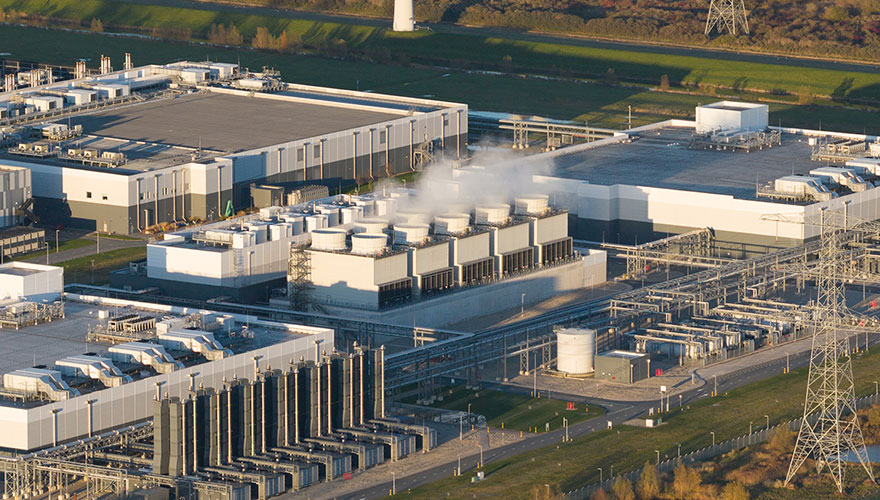
There’s a fundamental issues inside every modern data center, and it rarely shows up clearly in design documents.
These facilities depend on moving large volumes of air. Heat is constant, and as compute density increases, it becomes more difficult to manage efficiently. At the same time, many of these environments require strict control—not just of temperature, but of electromagnetic behavior. Signals must be contained, interference must be mitigated, and performance must remain predictable.
Air needs to move. Shielding is essential.
Designing systems that satisfy both requirements is where data center infrastructure becomes more than a collection of components. It becomes a coordinated system where airflow, cooling strategy, and electromagnetic protection are intertwined.
Why Data Center Cooling Is Shifting Toward High-Airflow Systems
As data centers scale, traditional cooling approaches begin to show their limits. Compressor-based systems still play an important role, but they introduce higher energy consumption and increased mechanical complexity at large scale.
This is why evaporative and hybrid cooling strategies have become more common. Instead of relying primarily on compressors, these systems use airflow as the main mechanism for removing heat. When designed properly, they offer meaningful improvements in efficiency.
But that efficiency depends on something very simple: air has to move freely. It needs clear pathways to enter, circulate, and exit the environment. The entire system is built around that movement.
The moment airflow becomes restricted, performance begins to degrade.
The Ventilation Problem in EMI Shielded Data Centers
In a typical facility, ventilation is a straightforward engineering task. In a shielded environment, it becomes significantly more complex.
The enclosure itself acts as part of the system. Walls, seams, and structural elements form a continuous conductive barrier that blocks electromagnetic energy. That barrier only works if it remains intact.
Ventilation interrupts that continuity. Every intake or exhaust opening becomes a potential pathway for electromagnetic leakage. What looks like a simple mechanical requirement can undermine shielding performance if it isn’t handled correctly.
This is one of the most common issues in shielded environments—not because shielding is overlooked, but because airflow and shielding are treated as separate problems.
How EMI Shielding Works in Data Center Enclosures
EMI shielding is built on continuity. A properly designed enclosure behaves as a Faraday cage, preventing electromagnetic energy from entering or escaping.
But shielding performance isn’t determined by materials alone. It depends on how those materials are connected, sealed, and penetrated. Every interface matters. Every opening must be considered.
If even one element is treated as an afterthought, the overall effectiveness of the system can be reduced. That’s why airflow cannot be designed independently in environments where shielding is required.
Why Vent Openings Compromise Shielding Integrity
From a mechanical perspective, a vent is simply a pathway for air. From an electromagnetic perspective, it behaves very differently.
Openings can allow external interference to enter or internal emissions to escape. At higher frequencies, even small apertures can have a measurable impact on shielding effectiveness.
In data centers, these problems are often subtle. They don’t always appear as immediate failures. Instead, they show up as inconsistent performance, unexplained interference, or issues during compliance testing.
In many cases, the root cause is ventilation that wasn’t designed with shielding in mind.
How Honeycomb Waveguide Vent Panels Maintain Airflow and EMI Shielding
Honeycomb waveguide vent panels are designed to do exactly that. Their structure consists of tightly arranged conductive honeycomb shaped cells that allow air to move through while limiting the propagation of electromagnetic waves.
Each cell acts as a controlled waveguide beyond cutoff (a small fraction of a full wavelength) pathway. Air flows with minimal resistance, but electromagnetic energy—particularly at higher frequencies—cannot pass effectively through the same electrically small metal structure. This allows the enclosure to maintain its shielding performance while still supporting the airflow required for cooling.
Instead of forcing a compromise, the design combines the behavior of air and electromagnetic energy.
Balancing Airflow, Pressure Drop, and Shielding Performance
Even with the right approach, balance is still required.
The physical characteristics of a honeycomb waveguide—its depth, cell size, and open area—directly influence both airflow and shielding effectiveness. Increasing attenuation often introduces more resistance to airflow, while maximizing airflow can reduce shielding performance.
There is no universal configuration that works for every application. The correct solution depends on the specific requirements of the system, including airflow targets, cooling strategy, and shielding levels.
This is where coordination becomes essential. HVAC and electromagnetic shielding decisions must be aligned from the beginning.
Using Evaporative Cooling in Shielded Environments
Evaporative cooling makes this balance even more important. These systems rely heavily on airflow, so any restriction has a direct impact on performance.
If airflow is limited, the system compensates. Fans work harder, energy use increases, and cooling efficiency declines. Over time, that can affect both operational cost and reliability.
This doesn’t mean evaporative cooling isn’t suitable for shielded environments. It means the system has to be designed with both airflow and shielding in mind from the start.
Why Honeycomb Waveguides Vent Panels Outperform Mesh and Perforated Panels
It’s common to assume that any perforated surface can solve an airflow problem, but shielding performance requires more precision.
Mesh and perforated panels allow air to pass, but they don’t control electromagnetic propagation in a consistent way. Their performance varies depending on frequency and configuration, which can create gaps in shielding effectiveness.
Honeycomb waveguide panels are engineered specifically for this purpose. They provide predictable attenuation while maintaining airflow, making them a more reliable solution in environments where both are critical.
Design Considerations for HVAC and Engineers
At a practical level, this is about alignment.
HVAC professionals are focused on airflow performance and system efficiency. Engineers are focused on shielding integrity and compliance. Both perspectives are necessary, but neither is sufficient on its own.
The most successful systems are the ones where these requirements are addressed together, allowing airflow and shielding to function as parts of a single, integrated design.
MAJR Products: Supporting Shielded Ventilation in Data Centers
At MAJR Products, we work at the intersection of these challenges.
We understand the realities of airflow in HVAC systems, and we understand the importance of maintaining shielding integrity in critical environments. Our honeycomb waveguide panels are designed to support both, helping teams implement solutions that perform as intended in real-world conditions.
Because in environments like these, airflow and shielding protection aren’t competing priorities. They’re shared requirements.
Frequently Asked Questions
Subscribe
Data Sheet Download
Data Sheet Downloads -
Click Here For All Our Data Sheets